
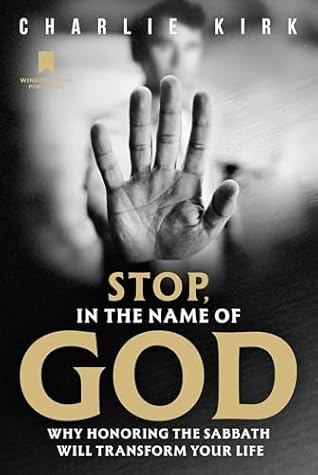
Book Review: Stop, In the Name of God

Stop, in the Name of God by Charlie Kirk

Stop, in the Name of God: Why Honoring the Sabbath Will Transform Your Life
by Charlie Kirk

5 out of 5 stars

In this book we explore the observation of the Sabbath, both as a way to find rest and to honor God. We learn how, from the very beginning of creation, God set in place a separate time to cease from working. God “rested” on the seventh day of creation, not because He was tired, but because the work was complete. The whole first chapter talks about creation, and how believing in a Creator God changes our entire perspective on life, knowing that we have a purpose and our work in life also “finds purpose when it moves toward rest.” The author describes the Sabbath as a “cathedral in time.” A time of beauty and sanctuary where we can meet God.

Continue reading
Book Review: The Liberty of Obedience

The Liberty of Obedience by Elisabeth Elliot

The Liberty of Obedience
by Elisabeth Elliot

5 out of 5 stars

This book explores the deeper meaning behind spiritual obedience to God, and how it is not limiting but liberating. Elisabeth Elliot draws on her experiences living with the Aucas native tribe to strip away all the distractions of American culture and all the social rules that we mistake for God’s rules. When you consider only the instructions of the Bible, obedience to those instructions becomes very simple and joyful.

Continue reading

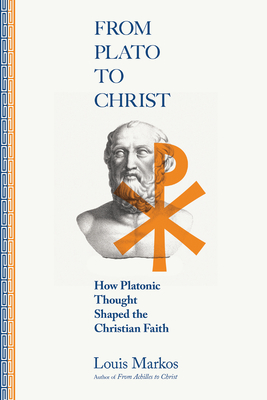
Book Review: From Plato to Christ

From Plato to Christ by Louis A. Markos

From Plato to Christ: How Platonic Thought Shaped the Christian Faith
by Louis A. Markos

5 out of 5 stars

The philosophy of Plato prepared the way for Christianity to be widely accepted in the ancient world. Socrates and Plato had a way of asking the right questions, even if they didn’t know the true answers that can be found in the Bible. Their philosophy points the way for a searching soul to find the truth of Christ. There are some spiritual things that are well-known to all of creation in general revelation, and Plato used that limited knowledge to formulate his own ideas about virtue and spiritual life. His philosophy directly reflects and leads to the specific revelation of truth in the person of Christ.

Continue reading

Book Review: The Mind of the Maker

The Mind of the Maker by Dorothy L. Sayers

The Mind of the Maker
by Dorothy L. Sayers

5 out of 5 stars

Dorothy Sayers explores the intricacies of the creative mind, connecting how our creativity functions with how the Creator God also works within the Trinity. She examines the nature of art and why mankind feels the urge to create, just as God created us. We ask questions about life and death, free will, and what it means to be created in the “image of God”.

Continue reading

Book Review: The Weight of Glory

The Weight of Glory, and Other Addresses by C.S. Lewis

The Weight of Glory, and Other Addresses
by  C.S. Lewis

This collection of essays from C.S. Lewis includes “The Weight of Glory”, which explores humanity’s innate desire for God. The essay says that the ultimate reward for a Christian is, not just to know God, but to be known by God. To be acknowledged and to receive approval from the Creator is the very essence of “glory”. Lewis talks from his own experience about how one of the most awful human experiences is to be ignored as if you did not matter, but to be noticed and invited in and welcomed as one who belongs is the highest happiness. We are not only to delight in our own glorious fellowship with God, but to also delight in the glory of our fellow human souls. Appreciating God and enjoying His Presence is the ultimate goal and design for every soul.

Continue reading

Book Review: George MacDonald Anthology

George MacDonald by George MacDonald

George MacDonald
by George MacDonald (edited by C.S. Lewis)

4.5 out of 5 stars
I really enjoyed reading through this anthology of MacDonald quotes, compiled by C.S. Lewis. It definitely gives you an insight into how MacDonald influenced and inspired Lewis.

Continue reading

Non Fiction Book Review: God in the Dock

God in the Dock by C.S. Lewis

God in the Dock: Essays on Theology and Ethics
by C.S. Lewis, Walter Hooper (Editor)

4 out of 5 stars

This collection of essays and letters from C.S. Lewis covers a wide range of topics, including Christmas traditions, miracles, vivisection, morality, dogma, and prayer.
He talks about how a God who is good can allow pain in the world, briefly summarizing concepts from his book “The Problem of Pain.” He talks about the common man of his day and their objections or misunderstandings that keep them from believing in Christ. He talks about the decline of religion in Britain, and the Christian truths hidden in pagan mythology. He answers questions, refutes common mistakes of his contemporaries, and responds to criticisms from his fellow intellectuals.

Continue reading

Book Review: Knowing God

Knowing God by J.I. Packer

Knowing God
by J.I. Packer

5 out of 5 stars

This book examines the attributes of God and how we can truly know God in a personal way. It begins by outlining the type of attitudes we should have in approaching God with humility and a desire to know the truth. The second part of the book focuses on the attributes of God in His unchanging Triune nature- His majesty, wisdom, love, grace, wrath, truth, judgement, goodness, and jealousy. The last part of the book applies all these things to the Christian life, and gives us a practical look at what knowing God actually looks like in living out your life.

Continue reading

Non Fiction Review: The Abolition of Man

The Abolition of Man by C.S. Lewis

The Abolition of Man
by C.S. Lewis
4 out of 5 stars

Lewis shows the implications of the philosophical ideas that emotions are crude and invalid, and only “reason” should dictate our actions. Reason without emotion is unreality, and even if it were true it would only lead to the abolition of mankind. Lewis attacks the issue from several angles, debunking popular arguments that the purest form of reason is our instincts, or that benevolent actions can be found through pursuing “science” as the best moral compass for mankind to follow.

Lewis proves that moral absolutes do exist and that they are universal through all generations and cultures throughout all of time. These moral absolutes appeal to both our reason and our emotions, and you cannot cut them out of a person’s life without destroying that person. There are basic truths that are self-evident and omnipresent in all mankind.

Continue reading