
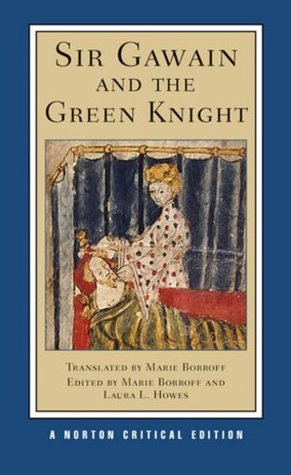
Sir Gawain and the Green Knight
byGawain Poet, translated by Marie Boroff
4 out of 5 stars
( There are spoilers for this classic! )
This classic poem follows the adventures of Sir Gawain, when he is called to take on a quest presented by the mysterious Green Knight at King Arthur’s court. The Green Knight challenges the bravest knight at court to exchange one blow with his axe and take the consequences. Sir Gawain accepts the challenge, and chops off the Green Knight’s head. But the Green Knight is unhurt, picks up his own head, and enjoins Sir Gawain to meet him at the Green Chapel in a year’s time, when the Green Knight will then return the blow.
The next year, Sir Gawain goes searching for the Green Chapel and meets with a kind knight and his lady at Christmas time. They invite him to spend the Christmas season with them in their castle, and they all feast together. The good knight and Sir Gawain make a pact that they will exchange whatever they receive in their day of hunting or recreation. The good knight’s wife tries to tempt Sir Gawain, but he remains courteous and aloof. In courtly courtesy, she gives him an innocent kiss, and he dutifully gives the kiss again to her husband at the end of the day, per their agreement to exchange whatever they receive. Each day, she tempts him again, but only gives a kiss, nothing more. But on the third day, he accepts from her the gift of a belt that she claims will make him invulnerable to harm. Fearing for his life, he keeps the belt a secret, and does not exchange it with the good knight as he had promised. He hopes the belt will save him from the axe blow of the Green Knight.
When he meets the Green Knight the next day, Sir Gawain is astonished to discover that the good knight who has been his host all through Christmas is the Green Knight in disguise, and he has been testing Sir Gawain’s courage and honesty. He told his wife to tempt Sir Gawain, and to offer him the belt. Sir Gawain is ashamed of his cowardice and dishonesty in withholding the belt, but the Green Knight forgives him, saying that Gawain’s confession has purged and purified his soul. Sir Gawain returns to King Arthur’s court and tells all the truth of his adventure, admitting his faults before all the court. But they all admire his humility and grace, and he is welcomed back with joy!
This poem is translated by Marie Boroff with partly alliterative verse and partly rhyming verse. So each section will have four lines at the end that rhyme, but the rest of it is alliterative. Instead of the words matching at the end of the word, they match at the beginning of the word. It’s really a very clever translation. I think it’s really well done! Some of the alliteration is just so satisfying! It’s such a delight to see certain groups of words coming together so perfectly.
The main theme of the story is the testing of the values of King Arthur’s court. It is said that no knights of any nation are so courteous and so courageous as those in Camelot. So the Green Knight decides to test that, and calls for a challenge to the most courageous and most courteous of them all – Sir Gawain, the king’s own nephew.
When Sir Gawain first accepts the Green Knight’s challenge, he says, “I am the weakest, well I know, and of wit feeblest, and the loss of my life would be least of any.” He shows humility at the beginning, but through his adventures, he begins to realize that he has carried a hidden pride that has to be revealed and purged from his heart.
So after a year, he sets off to find the Green Chapel, saying, “In destinies sad or merry, true men can but try.” He has this kind of staunch courage that is almost a type of despair, like he has lost all hope. He knows he’s going to die at the hands of the Green Knight.
Then he is tempted and he accepts the gift of the belt, because suddenly he has a glimmer of hope that he might survive his encounter with the Green Knight if the magic of the belt can protect him. So instead of relying on God to protect him, as a good Christian knight should do, he devises his own desperate plans, and breaks his promise to his host and sacrifices his honor in doing it.
What’s interesting is the very next scene after he accepts the belt and hides it – he goes to church, and prays “to be taught to lead a better life and lift up his mind.” It’s amazing how we can compartmentalize and do something sinful or dishonest one moment, and the very next moment be praying to be a better person, but with no intention of actually changing our behavior. But his prayer was answered. He WAS taught to lead a better life, but humiliation and shame was his teacher.
When he realizes how the Green Knight has tricked him, Sir Gawain says that his virtue has been laid low. He says he learned cowardice by caring for his life more than his honor, and that coveting the belt made him disloyal and false. He begs the Green Knight to forgive him, and the Green Knight says that he considers Sir Gawain’s confession to have made him pure again.
The whole story is this cautionary tale to any good people who think they are doing pretty well. We all have feet of clay. The Bible says “Let him who thinks he stands, take heed lest he fall.” That exactly describes Gawain. He’s not a supernatural hero. He’s human. He gets scared. He makes mistakes. He doesn’t keep his promises. Just like all of us, he needs Christ to forgive and heal him.
I really loved that a lot of the story was focused on the Christian faith of the characters. Sir Gawain and the good knight and many of the characters are often calling on the King of Heaven to protect and bless them. All the greatness of Camelot and the virtue of the Knights of the Round Table centers around their Christian faith.
There was only one thing that I did not like in the poem- a large portion of the story was taken up with descriptions of the good knight hunting each day during the Christmas season, and then he brings back whatever they killed to exchange with Sir Gawain per their agreement. The descriptions just go on and on about the clothing he wore, and the horse he rode, and the dogs, and the deer and the fox, and the kill, and the blood and guts and entrails when they cleaned the meat. And then they do it all again on the next day! There are three big sections describing every little detail about the hunt on each day. On and on and on…. It was just too much!
But I really enjoyed the witty scenes between Sir Gawain and the lady, because she is trying to tempt him and entice him, but he keeps putting her off with courteous words and sparkling witty jests, without hurting her feelings. It’s like they are verbally sparring and playing this super polite cat-and-mouse game. Utterly brilliant!

