
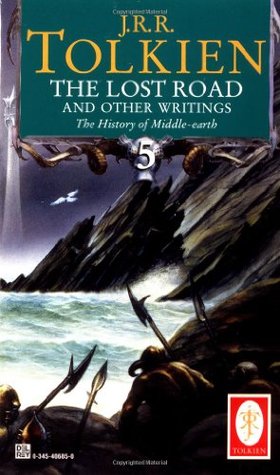
The Lost Road and Other Writings (The History of Middle-Earth, #5)
byJ.R.R. Tolkien, Christopher Tolkien (Editor)
This book compiles some unfinished manuscripts and snippets of stories from Tolkien, along with earlier manuscripts of The Silmarillion, and etymologies of languages and names in Elvish.
The first snippet of a story is an outline of the Fall of Numenor, with three different versions, each slightly different and more evolved.
That dovetails perfectly into the second section which is the unfinished manuscript of The Lost Road, a story about a modern man and his son who have dreams of the ancient past that lead them to Atlantis/Numenor. There they witness the dark days of Numenor when Sauron was spreading his lies and the Numenorians were obsessed with defeating death. A Numenorian father and son much like themselves are debating what to do about the spread of Sauron’s power, and they are worried about spies reporting them to Sauron. But then the manuscript finishes right there, with some notes from Christopher Tolkien about his father’s plans to rework the story, which never came to fruition.
This is Tolkien’s attempt at writing a time travel story, according to his agreement with C.S. Lewis that one of them would write about space travel (which Lewis did in Out of the Silent Planet) and the other would write about time travel, as Tolkien began to do with Numenor as a version of Atlantis. It’s a real shame that it was never finished, because it was fascinating to see Tolkien writing about modern people hearing echoes from the ancient legends.
There is also some beautiful poetry where Tolkien retells the legend of King Sheaf/ Scef/ Sceafa with some inspiration from mentions of King Scyld Scefing in Beowulf. This story begins with an old bard at the king’s hall who begins to tell the poetic tale of how King Sheaf was shipwrecked on the shores of a poor village, and he taught them to sing and harvest. Under his wise kingship, the people prospered and grew wealthy, and he fathered many noble sons, but in his old age, he mysteriously returned to the sea and some say that he found the “straight road” to the uttermost West.
It’s written in the alliterative verse that Tolkien loved for its Old English and Anglo-Saxon roots. Here are a few lines that show the alliterative style: “The ship came shining to the shore driven and strode upon the strand, till its stem rested on sand and shingle. The sun went down. The clouds overcame the cold heavens.” This was so beautifully and thoughtfully written, as all of Tolkien’s writings are. I really enjoyed reading it, and I wish that he had finished the entire thing.
Then we have early manuscripts from The Silmarillion covering the creation of the world by Iluvatar, the Valar and the creation of the Trees in Valinor, how elves and then later men first awoke in Middle-Earth, how the Silmarils were created and how the elves fought civil wars over them, and the many wars with Morgoth and how Ungoliant destroyed the Trees, etc…
If you haven’t already read The Silmarillion, then you might get lost, because some characters are mentioned very briefly in the early manuscripts. It’s not until later that Tolkien really fleshed out their stories properly into the legends that we know. So I would definitely recommend reading The Silmarillion first, so that you are already familiar with the extensive legends of Middle Earth.
There are sections that discuss the way that the different languages of the elves developed over the ages in Middle Earth, and a section about the etymologies of different words and names. There are also a few maps in an appendix at the back, along with a list of genealogies of the main houses of Men and Elves.
Overall, I really enjoyed rereading this book for the second time, especially for the snippet of The Lost Road and the bit of poetry about King Sheaf. I admit that I skimmed through most of Christopher Tolkien’s commentary about this early manuscript or that little note scribbled in the margins, but I took my time reading the actual narratives. It’s a testament to Tolkien’s genius that even a little note scribbled in the margins is utterly fascinating!

