
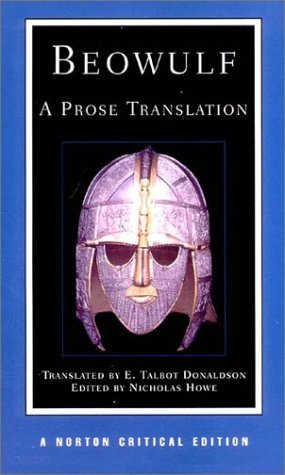
Beowulf: A Prose Translation
by Talbot E. Donaldson
4 out of 5 stars
Beowulf hears of a murderous monster that is attacking Hrothgar’s kingdom, so he journeys across the sea to aid the mighty king. Beowulf refuses to use a sword against the terrible monster Grendel, choosing instead to trust in his own great strength in hand-to-hand combat. He beats Grendel and tears off the monster’s arm. Grendel flees, but bleeds to death elsewhere. Grendel’s mother swears revenge against them, and attacks the next night, killing Hrothgar’s best counselor. Beowulf pursues Grendel’s mother to her underwater lair, and finds an ancient giant’s sword in the caves beneath the lake. He uses the sword to kill her, but the sword melts from the heat of her monster blood. Beowulf cuts off Grendel’s head and returns with it to Hrothgar’s court to show the proof of the monster’s death. After receiving many beautiful and costly gifts in recognition of his great deeds, Beowulf returns to his own land across the sea.
When Beowulf is an old man, a fire-dragon terrorizes his people. Beowulf takes a few of his warriors to confront the dragon, but they all fall back in terror, except one brave young man, Wiglaf, untested in battle, but determined to stand by his lord. Together they slay the dragon, with Beowulf delivering the final death blow. But Beowulf dies of his wounds from this battle with the dragon, and with his final breath asks for a great funeral mound to be built in his honor. Wiglaf punishes the cowardly soldiers, and gathers the dragon’s gold to generously bless the people and rule wisely after Beowulf.
I recently started reading Tolkien’s essay “Monsters and the Critics” and I just had to reread Beowulf, because Tolkien’s passion for this poem got me all excited to read it again.
One thing I really love about Beowulf is the symmetry of the story, telling about Beowulf’s first great exploits in his youth which first won him fame, and then telling about his tragic death protecting his people. It’s a great bookend to see the beginning and the end of a man’s life, his triumphs and the tragedy of his defeat.
That is one of the main themes of the book – the inevitability of death. You might win some battles, but everyone has an appointed time to die. That is repeated several times about many different characters’ deaths – that it was their day, their time to die. It makes the other characters feel so helpless that they could not stop death, and they all reflect on their own death that will come at some unknown time. When Beowulf is triumphant against Grendel’s mother, he says that God was guarding him in the fight. There is a kind of grim courage in facing death and striving to do something good before your life ends. Beowulf says, “Each of us must await his end of the world’s life. Let him who may get glory before death.”
Since I started reading Beowulf mainly because of Tolkien’s critical essay, I was thinking about Lord of the Rings as I read, and I found a lot of parallels and obvious influences from Beowulf on Tolkien’s writing, especially in the culture and language of the Rohirrim. There are a lot of themes and cultural values that are similar to the Scandinavian cultures in Beowulf. Their extreme glorification of courage is one of the most prominent. We see those themes in both Beowulf and in the Lord of the Rings of the “unyielding will” that fights against evil even when the situation is hopeless, and defeat and death is coming. This is a strong virtuous soul that stands against evil to protect what is good, even at the cost of their own life. Both Tolkien and the author of Beowulf understood “the worth of defeated valour.”
There are also a lot of compound words that Tolkien imitates in the speech of the Rohirrim, such as ‘shield-maiden’ and ‘ring-bearer’ being similar to ‘helm-bearer’ and other words in Beowulf. Some of my favorites in Beowulf are the description of someone’s skull as a ‘head-bone’, or the dragon as a ‘hoard-guard’. These compound words are so much more expressive than a single word or adjective could be! Really beautiful writing!
I recently read a book that misunderstood Eowyn’s character in Lord of the Rings, saying that she was intent on becoming famous, because her culture talks about “winning renown” for glorious deeds in battle. Any close examination of these ancient Germanic and Scandinavian cultures shows that the fame they are seeking is not self-serving, but selfless service to their people resulting in a justly-given praise for virtuous deeds. This is very clear in Beowulf where it says that “He rejoiced in his night’s work (killing Grendel), a deed to make famous his courage. … so too had he remedied all the grief… that they had endured before…” He is glad to be famous for doing a service to the people. Even in Heaven, we are told that we will be rewarded for our good deeds and praised with the words, “Well done, thou good and faithful servant.” This type of celebration of virtue and good deeds is the “fame” of merited praise that Eowyn and Beowulf are seeking.
I think this prose translation does a good job of capturing the power of the story of Beowulf with the high and weighty language of the original kept intact. This story is not really an epic in the way that the Greeks wrote epics. It’s more of an elegy, a dirge at the end of a hero’s life to celebrate his early achievements and his final battle.
Tolkien says that some critics dislike the inclusion of mythical monsters in the story, but Beowulf transcends the petty wars of men and must grapple with something supernatural if we are to understand the deeper themes of good and evil, death and life in their proper supernatural context. Beowulf comes to us an echo from the ancient past with messages that still resound and echo in our human hearts today.

