
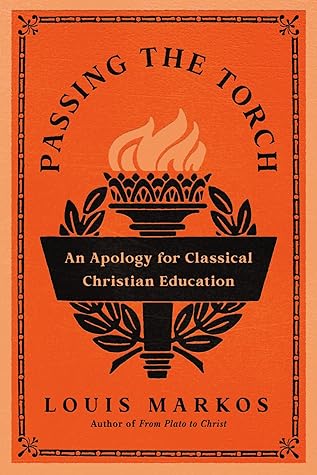
Passing the Torch: An Apology for Classical Christian Education
by Louis Markos
This book examines modern philosophies of education and compares them to classical education and especially to Christian education. We begin with the question of the nature of mankind. The entire preface establishes that we are incarnational beings with both body and soul, we have a dualistic nature of both good and evil possibilities inside us, we are moral agents responsible for our own choices, and we are habitual beings who are capable of learning and changing. Therefore, one of the main objects of education is to train people to have the habit of virtuous living and right thinking, so that we react properly to good or evil. We are also subcreators, so we create stories and narratives to explore truth and define our place in the world. We are builders, so we have a desire to create order in a chaotic world. We are political, meaning that we function inside a community, and the purpose of education is to train citizens who are self-regulating within their society.
In order to define a proper philosophy of education, we must first understand who we are educating. I really love that this book starts from that point and gives a very clear picture of mankind, so that educators can then figure out exactly what our job is and what we ought to be teaching.
Then we tackle the differences between a liberal arts education (that focuses on language, logic, rhetoric, math, music, gymnastics, and philosophy) and a vocational education that equips someone with skills to do manual work. Both are important, but a liberal arts education educates the entire person, body, mind, and soul, whereas a vocational education leaves the mind and soul wandering in ignorance. A vocation can teach you to be productive in your community, but a liberal arts education teaches you what it means to be a person, making moral choices as you interact with your community.
The main purpose of a liberal arts education is to teach students the habit of virtue, and to do that you need a divine standard by which to measure morality. The author says that virtue cannot exist in a “morally relative vacuum”.(pg.39) There has to be absolute fixed truth and goodness and beauty, or education falls apart because there is “nothing against which to measure the goal and the quality of the instruction.”
I love that this book has a focus on studying history and gleaning wisdom from the books of the past. You have know where you are coming from to be able to see where you are going. With all of history behind us, we can see what to avoid and what to mimic, “forming human character in harmony with an ideal sense of balance and proportion.” (pg.43) I think so many people today are missing a sense of proportion because they have not properly studied their history. A student who studies history has “a sense of themselves as participants in the flow of history and the choices of their ancestors.” (pg. 77)
One chapter is devoted to canonical education. The author says that a true educator must expose the students to “timeless and time-tested works that have proven themselves to be worthy of long and careful study and contemplation.” These are the “Great Books” of Western culture that teach people their heritage and how to function in their own culture. Dante, Shakespeare, Plato, John Milton, Austen, Dickens, Chaucer, Machiavelli, on and on, all the great writers. The author says “…the best way to instill virtue in young people was to embody those virtues in stories.” (pg. 119)
If you want to “wrestle” with deep philosophical questions about purpose and belonging and morality, then you have to explore the works of the great authors and thinkers of the past. The author describes it as “joining in the Great Conversation” of philosophers who have been asking the big questions since time began. The author says “they are those who have stared deeply into the abyss of self and returned to teach us what they saw and heard. By reading and reflecting on their works, we are challenged to put in order our own wandering thoughts and feelings…”(pg.61)
I also really liked the chapter on books vs. textbooks, where the author argues that it’s not enough for students to read a summary or an excerpt in a textbook and call that education. Students should be reading entire books and experiencing these great thinkers for themselves. That is the only way to reach their souls with these timeless stories and poems that touch the heart and change people from the inside out. Of course there are textbooks that are appropriate for certain subjects or particular lessons, but students should be receiving a more hands-on education where they experience things first-hand.
Too many textbooks filter history through a modern lens that looks on the past with a sense of superiority, as if the present is so much more enlightened and the past was full of fools. Students are taught to criticize the authors and thinkers of the past, instead of being taught to humbly learn from them. The author says “To stand naked and face to face with the Great Books is to have our thoughts tested and our actions altered. Those same works, when they are filtered through a textbook that defangs, deconstructs, and domesticates them, only reinforces our feelings of smugness, self-satisfaction, and self-righteousness.”(pg. 71)
I really liked what the author had to say about classroom management being a social science where “students end up being more herded than taught, controlled than nurtured.” Order in the classroom is necessary for learning, but social experiments in schools end up being more about regulation and statistics rather than about teaching anything to the actual child in front of you. What they call education teaches a child how to take tests. A true education will teach the child to love learning. “Students who fail to develop the power to continue acquiring their own knowledge will never be fully educated.” (pg. 109)
Students are taught relativistic “values” rather than concrete “virtues”, and the consequence is that they feel no shame when they do something wrong because they have not been taught the correct responses to good or evil in others or themselves. They are left adrift in a moral wasteland… but they scored well on a standardized test, so off they go into the world to live their lives with no education on how to actually live. But the social experiment has the measurable results that they tested for, so we call that an education.
They are “enslaved to whatever fashion or trend is currently in vogue” (pg. 104) because they have no fixed standard by which to measure their life. The author says that civilization is a garden, and educators are the gardeners. We have to teach people to recognize and desire truth, goodness, and beauty if that garden is to flourish and grow.
My favorite part of the book was when the author talked about the “lightbulb flash” moment when a student suddenly understands a new concept and connects with what is being taught. I LOVE that moment! I’ve been teaching for 25 years, and it’s the best thing to see a student when their face lights up with understanding and there is this fire in their eyes as they get to apply what they have learned and really understand the meaning behind all that knowledge and information that I’ve been pumping into their little brain for months. The best part is that their “spirit of inquiry” as the author calls it (pg. 109) has been ignited, and they are eager to learn more and reform that information into their own way of expressing it.
The last sections of this book explore some different models of education and educational philosophies throughout history, including Plato, Augustine, Jean-Jacques Rousseau, John Dewey, C.S. Lewis, Dorothy Sayers, Charlotte Mason, Mortimer Adler, and others. We compare classical education and Christian education with relativistic modern education, and we go through the history of education in America and how things have changed in the last one hundred years.
I really loved the chapters on C.S. Lewis and Dorothy Sayers! C.S. Lewis wrote an essay, “The Abolition of Man”, which examines the education system and how relativism and subjectivism have broken down all wisdom and virtue, and left “men without chests” who have no compass within to guide them through life. If everything is relative, then nothing can be known. Nothing can be taught. You have nothing to hold onto, so you just drift through life. Such people are in rebellion against reality. A true education will teach you that there are absolutes – absolute truth and goodness and beauty – and it “reconciles us to reality.” (pg. 173)
Dorothy Sayers wrote “The Lost Tools of Learning”, calling for an education that will “free the mind, arming it against faulty logic, emotional appeals, and manipulative propaganda.” (pg. 179) She defines three different learning stages as children grow up, and shows how they are perfectly aligned with classical education to learn grammar, logic, and rhetoric as young children, then preteens, and finally as teens growing into adults. I really enjoyed reading that section because it’s so easy to recognize these different learning stages in my own students!
Overall, this book is so brilliant, and I found a lot of great wisdom that I can apply to my own teaching!
Disclaimer: I received a copy of this book from the publisher in exchange for a free and honest review.

