
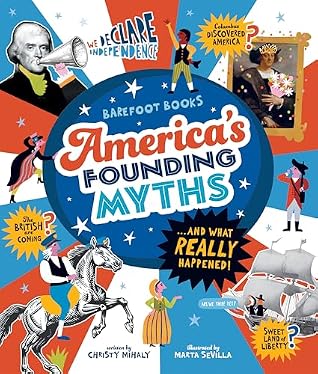
America’s Founding Myths…And What REALLY Happened
by Christy Mihaly (Goodreads Author), Marta Sevilla (Illustrator)
This book examines myths that some people believe about American history and tries to set the record straight. Unfortunately, it fails miserably.
The topics include the New World being discovered by Christopher Columbus, Pocahontas and John Smith, the Pilgrims and the first Thanksgiving, the Boston Tea Party, the Battle of Bunker Hill, Paul Revere’s ride, the Declaration of Independence and the Constitution, and women and Native Americans and Black Americans fighting in the Revolutionary War.
This book has so many problems. The text is clearly trying to undermine American history and deconstruct American heritage. The author uses half-truths to reframe history and misrepresent what happened.
Most of the “myths” aren’t myths at all, but the author claims that some people actually believe these “lies”, most of which I have never heard of. A better way to frame the historic information would be to say something like, “here are some extra details about Pocahontas that maybe you didn’t know” rather than saying that John Smith was a known liar and braggart (without any evidence shown). By using “myths” as the focal point of the book, the author is eroding the reader’s trust in American history rather than teaching some new or lesser-known information about history.
The preface specifically says that the founding fathers “made mistakes and created imperfect systems.” The whole focus of the book is on criticizing the past, rather than learning from the wisdom of the past and celebrating the good that they were able to do in the midst of difficult political situations.
The first “myth” is that “when Europeans arrived in what they called the “New World”, the continent… was mostly an empty and unpopulated wilderness.” I’ve never heard that before. Does anyone actually think that North America was unpopulated? Who actually believes that? The author just makes up “myths” as a way to introduce their ideology and give them a platform to criticize the past and take away natural patriotic admiration of our nation’s heroes.
The table of contents says “This book talks about stories from American history that are NOT true.” And yet, all the myths are mostly true, it’s just that some historic details are not commonly known. John Smith did meet Pocahontas. Paul Revere did ride. The Pilgrims and Native Americans did meet for the first Thanksgiving. Just because there are extra details which are not usually included in those stories doesn’t make the whole story untrue.
This book gives a very one-sided view of history. In the sections about Native Americans, there is a lot of emphasis on the violence from Europeans, and no mention of the violence of the Native Americans. The book makes it seem like all Native American tribes were just peace-loving innocent people, and the Europeans were all evil and greedy. If you are going to write about history, you have to tell both sides of the story without bias! This book doesn’t do that.
One of the sections says that Christopher Columbus didn’t “discover” the New World, because there were already people living there. I think that everyone understands that the word “discover” means that he discovered the existence of the American continents FOR Europeans and most of the civilized world. Just as Isaac Newton “discovered” gravity, but some people could claim that he didn’t really discover it because it was always there; he just gave it a name. It’s petty and silly to claim that Christopher Columbus didn’t discover America because Leif Erikson travelled there hundreds of years before. But Europe and Asia didn’t know about Leif Erikson, so the knowledge of continents across the Atlantic was a big discovery for them. The book is making very poor logical arguments for these “myths”.
Another ridiculous “myth” that I’ve never heard of is that ALL the patriots supported the actions at the Boston Tea Party. Who ever said that? Obviously the entirety of the colonies could not have ALL supported what Boston was doing, and it’s perfectly natural that even just the Bostonians would have had many different opinions over how to deal with political unrest. What person in their right mind would think that every single person in Boston would agree on anything? That’s utterly illogical. The author just made up a “myth” so they could “debunk” it.
This book also criticizes the Pilgrims who came to America on the Mayflower, saying that they did not believe in freedom of religion for all, but that they believed that their way of worship was the only right way. The entire section about Thanksgiving makes no mention of giving thanks to God, which is the whole purpose of the holiday. The author obviously has a poor opinion of religious people, and does not hesitate to show that.
Instead of focusing on how the young nation of America had more freedoms and rights for its people than any other nation in history, this book criticizes the founding fathers, the Declaration of Independence, and the Constitution, for not abolishing slavery from the beginning and giving more rights to Native Americans and women. Of course, America still had some work to do, but the nation was already years ahead of any other country on earth in granting rights and freedoms to its citizens and the framework of “liberty for all” was already in place.
The author acts as though no other country in the world had ever had slavery, whereas the truth is that every single country in the world has a history of slavery, but America was one the first nations to abolish slavery. Instead of celebrating the good, this book focuses only on the bad.
This book is so focused on criticizing everything from history that they can’t present a coherent picture of history. The author seems to have the belief that everything modern is superior to anything from the past, so they look back on everyone and everything in the past with a lens of foolish pride.
Rather than clarifying American history with facts, the author seems intent on creating confusion and doubt. There are very few sources, and the author makes wild speculations and accusations without showing the evidence.
The way this book is written is destructive rather than instructive.
Disclaimer: I received a copy of this book from the publisher in exchange for a free and honest review.
This book has been screened on the Screen It First website: https://screenitfirst.com/book/barefoot-books-americas-founding-myths-and-what-really-happened-2594882

