
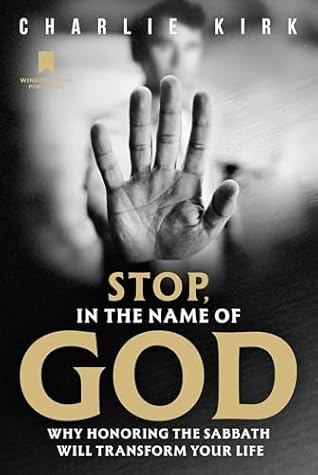
Stop, in the Name of God: Why Honoring the Sabbath Will Transform Your Life
by Charlie Kirk
In this book we explore the observation of the Sabbath, both as a way to find rest and to honor God. We learn how, from the very beginning of creation, God set in place a separate time to cease from working. God “rested” on the seventh day of creation, not because He was tired, but because the work was complete. The whole first chapter talks about creation, and how believing in a Creator God changes our entire perspective on life, knowing that we have a purpose and our work in life also “finds purpose when it moves toward rest.” The author describes the Sabbath as a “cathedral in time.” A time of beauty and sanctuary where we can meet God.
There is a really sweet foreword written by Erica Kirk that I found very touching, and it shows how Charlie Kirk and his family really lived out what they preached about honoring the Sabbath and finding rest in God’s peace. They advocate taking time to contemplate and communicate and connect, instead of rushing from one thing to another glued to our phones.
I really liked that this book establishes a foundation of faith, first proving that God does exist, and examining who God is and what He expects from us. From there, we can find rest in His loving commandments, including the commandment to “Be still and know that I am God.”
There was one quote that I really loved that says, “Freedom is not the absence of structure – it’s the presence of the right structure.” A time of Sabbath rest that is set aside for worship is the structure that God has designed for us to flourish. Resting in God helps us to recover the meaning in our lives as we walk in step with Him.
We get to explore the history of the Sabbath and how it was transformed into a Sunday celebration of Christ’s resurrection, leaving behind all the Mosaic restrictions and laws. We get a lot of beautifully scholarly history and quotes from famous Christian thinkers of history. I especially liked the sections about how Christ is the fulfillment of the Sabbath promise for deep spiritual rest. Christ calls us to rest in Him. He is our Prince of Peace! A Sabbath time of rest can give us outward rest to match the inner spiritual rest of Christ.
The author says that “The Sabbath is a sanctified protest against the tyranny of constant motion.” Our time is not our own, it is a gift from God, a sacred trust of communion and worship. Sometimes we worship with work, sometimes we worship with quiet rest. But we should not worship the work or worship our own abilities. The Sabbath reminds us that we are helpless without God. It is a surrender, laying down our weapons and saying, God is God, and I am not. I will obey His commands, including the command to rest. We have to trust that our life will not fall apart if we stop moving, because it is God that holds us together.
There is a whole chapter that explores what modern people worship instead of worshipping God. They worship money, the environment, their political party, their social reform cause, and mostly they worship themselves. All those things do not bring rest, they only bring more work, more loneliness, and more anxiety, because there is no meaning without Christ. Only in Christ can we be restored and healed, and the Sabbath is a way to enter into that restoration on a deeper level.
I was very intrigued by the chapter examining what a consistent Sabbath or Sunday time of rest will do for your health. The author quotes from scientific studies that have found that communities and churches with a strong belief in sacred rest have fewer health problems, better mental health, lower cortisol, less inflammation, better sleep, and more resilience to stress. But the Sabbath isn’t just a self-care hack. It’s part of a deeply personal relationship with God that brings health and healing.
I was really convicted by the section about smartphone addiction, and how it is literally rotting our brains and stunting our maturity. Little by little over the years, I’ve been using my phone less and less, and staying off social media for the most part, but this section inspired me to detox even further and really get unplugged so that I can give more attention to what matters – connecting with God and friends and family. That’s what the Sabbath is all about!
An interesting analogy is found in the Sabbath commandment when the people of Israel were commanded to rest on the seventh day BECAUSE they used to be slaves in Egypt. The implication is that you are not slaves anymore. A slave has to work and work with no rest. In God we have the freedom to rest. I am not relying on my own labor to provide for my life; I am relying on God to provide. So I can stop the endless striving. The work that I do in six days will be enough, and I trust God for the rest of it.
The author talks about sleep quality and how important it is to get not just adequate sleep, but truly restorative sleep. He mentions a lot of places in the Bible where sleep is prioritized. Even Jesus took a nap on the boat during a storm! Christ teaches us that resting is the ultimate expression of faith. We don’t have to earn our rest. It is a gift, a sacred covenant with God.
Taking time to rest on the Sabbath or Sunday is encouraged as a protection for what is most precious in your life, not as a burden or a strict set of rules to be followed. The focus is on what we embrace, not on what we avoid during that sacred time. It’s about enjoying the presence of God, recalibrating your health, reconnecting with your family, and worshipping with your spiritual community.
The final chapters give two sides of the argument about whether or not Christians are morally bound to observe the Sabbath, either on Saturday or Sunday. I really liked that the author presented both sides of the argument with clear reasons for each viewpoint, and then left it to the reader to make their own decision. I myself think I’m somewhere in the middle. I don’t think that Christians are bound to the Sabbath as a commandment, because our rest is complete in Christ, but I do think that it is wise to take the Sabbath or Sunday as a day of rest and worship because God created us to thrive in that holy rhythm that He instituted at creation.
I was especially inspired by the final section that examines all the excuses we make for ourselves about why we think we don’t have time to observe the Sabbath or Sunday. One of the biggest ones for me is perfectly described in this quote, “…silence exposes things we’d rather avoid – fear, anxiety, a lack of trust. So we keep moving, convincing ourselves that one day we’ll slow down. But we rarely do. … Rest requires courage. It means confronting our fear that the world will fall apart if we stop working. It means choosing trust over control.” That really convicted me about my own lack of trust in God, and I immediately started praying for more faith, more courage, and more rest. Resting can feel kind of vulnerable in a way, like a loss of control. But of course, all control is an illusion. Only God is in control, and we can only find true rest in His Love. If our identity is anchored in our work, resting feels like a loss. If our identity is anchored in Christ, resting is the ultimate gain. We gain all the peace and blessing that comes with a close walk with God.
This book is so beautiful and meaningful, and I loved every chapter!
 Luminous Libro