
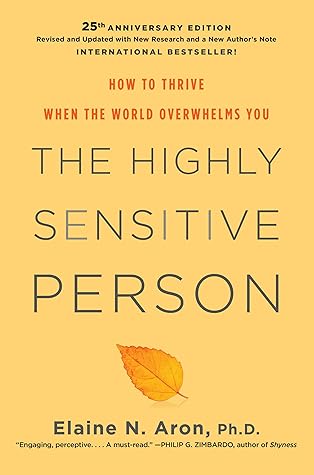
The Highly Sensitive Person: How to Thrive When the World Overwhelms You
by Elaine N. Aron
This book explores the personality trait of being highly sensitive and all the strengths and weaknesses that come with that trait. First, the book explains what high sensitivity actually is and what it isn’t, and then gives advice on how to navigate this unique ability.
Highly sensitive people are sometimes labeled as “shy”, but the personality trait goes far beyond labels. Being highly sensitive to light, sound, smells, foods, and any external stimuli can be both a blessing and curse, as you process things that other people are not even aware of. HSPs also have a much deeper understanding of the meaning behind things due to their deep processing.
The book focuses on how Western culture prizes extroverted personalities and judges those with quieter and more sensitive personalities, misunderstanding the introvert and forcing them to do extraverted social activities. The book gives introverts and HSPs (highly sensitive persons) tools to manage social activities on their own terms and within their comfort level/tolerance for external stimuli.
HSPs are processing a lot more information than non-HSPs, and their depth of processing can lead to wonderful breakthroughs and personal victories, but there is also a possibility of being overwhelmed. HSPs need a lot of quiet alone time to process everything they experience.
This book has sections that examine the life of an HSP in various situations, such as work life, childhood, relationships, friendships, family dynamics, medical concerns, and spiritual life.
Most of it is helpful and hopeful, but some of the focus was on overcoming abuse and there are some really awful stories of HSPs who suffered abuse, molestation, violence, depression, suicide, all kinds of horrible things. I suppose those things need to be addressed so that the author can cover a wide variety of experiences and help people in every situation, but I found it very disturbing to read about.
Overall, there is some good advice in this book, but I had already heard most of it from other sources, so there was nothing new in here for me. Still, it was nice to be reminded of how my personality trait can be a strength as well as a challenge at times, and learn about ways to lean into the strengths and minimize the difficulties of being highly sensitive.
I did not connect with the clinical approach in the writing. It is good to know that studies have been done to prove the veracity of all the material in this book, but I just didn’t personally connect with the writing style. And when there are anecdotes about various HSPs and their life experiences, it was mostly horrible things that happened to them and how they were bullied and abused.
I felt like the chapter on social relationships had some good advice but was too analytical. Sometimes you just like someone and you don’t need to analyze the relationship to death. If you overthink it, things can fall apart. I’m already overthinking everything. I didn’t need this book making it worse.
There is also a lot of emphasis on Jungian psychology, and some of those ideas were just ridiculous. Some Freud is also mentioned and that was weird. There were a few other belief systems in the book that do not align with my own worldview at all. The chapter on spiritual health was just stupid. That chapter had every belief system in the world thrown in together plus the kitchen sink. Just idiotic. There were these anecdotes of people who saw visions and all kinds of creepy things, and it’s supposed to illustrate how HSPs are spiritually aware or something. So strange and creepy.
Overall, some good things. Some stupid things. Some horrid things. It’s a mixed bag.
 Luminous Libro