
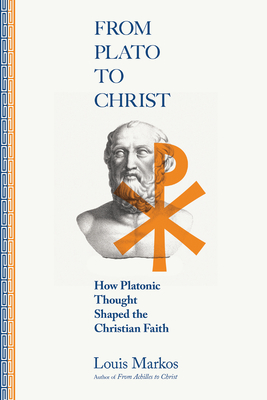
From Plato to Christ: How Platonic Thought Shaped the Christian Faith
by Louis A. Markos
The philosophy of Plato prepared the way for Christianity to be widely accepted in the ancient world. Socrates and Plato had a way of asking the right questions, even if they didn’t know the true answers that can be found in the Bible. Their philosophy points the way for a searching soul to find the truth of Christ. There are some spiritual things that are well-known to all of creation in general revelation, and Plato used that limited knowledge to formulate his own ideas about virtue and spiritual life. His philosophy directly reflects and leads to the specific revelation of truth in the person of Christ.
I loved the writing style of this book! It’s scholarly, but easy to read and understand even if you know nothing about Greek philosophy. We not only explore the way in which the pagan philosophies point to Christ and a Creator God, but also how the myths and analogies have shaped literature and all of Western thought. Each chapter gives a synopsis of the basic dialogues of Socrates and Plato and what they taught, and then we can analyze the main themes and symbols and see how they prepared the way for Christianity.
There are several chapters detailing how the early Christian leaders used the dialectic structure of Plato to explain deep spiritual concepts like eternity, grace, sin and sanctification, and our place in the cosmos. Because Plato had already laid the intellectual foundation, Christians were able to build logical arguments to reveal God’s truth and further His kingdom.
One of the most famous of Plato’s analogies is that of the cave. He says that we are like people stuck in a cave, and we can only see the wall in front of us where there are shadows cast by a fire behind us. If you could get out of the cave, you would see reflections of the sun in the water, and then finally by degrees your eyes would be strong enough to look into the sky and see the sun.
People who are still stuck in the cave think that the fire IS the sun, because they have never seen the real sun. Plato says that this is like a person who is spiritually blind. They are obsessed with the shadows of things in the physical world, when the reality of life is in the spiritual world outside the cave. The Bible also teaches that the things we see and experience on earth are only imitations of greater and higher heavenly things which are the originals of reality.
Most of Plato is spent discussing the nature of concepts like justice and virtue, and trying to define the inner struggle of the soul. The “psychomachia” is the war of the soul within itself, battling between temperance and passion, courage and fear, and wisdom and ignorance. Plato believed that the way to find a healthy balance in the soul was to ascend the rising path of virtue. Every decision we make either nourishes our soul or damages it, leading us up the path to get out of the cave of ignorance and vice, or leading us further into the depths of darkness.
Although Plato believed in reincarnation and a lot of weird religious trends of his time, his reasoning and the basic arguments behind his philosophies are sound, even if some of his conclusions are incorrect due to the limited general spiritual knowledge available to him. The author of this book chooses to look at Plato’s beliefs in reincarnation as allegorical myths, showing the ascent of the virtuous soul on the rising path, or the descent of the evil soul into bestiality. Seen as an allegory for sin, grace, and Christian sanctification, the myth can point us to the truths in the Bible and further illustrate that there is an innate knowledge of good and evil even in the most pagan of beliefs. In another chapter, Augustine says that Christians are the rightful owners of all truth, and that they should not hesitate to defend it wherever they might find it, even in the writings of pagan religions.
The main four virtues that Plato defines are wisdom, justice, self-control, and courage. They must all work in balance within the soul to create a virtuous life. Plato believed that ignorance and pride were the root cause of all evil choices. Although he did not have a concept of sin as taught in the Bible, Plato did believe that all human actions should be measured against a divine standard, and not just guided by a relative human moral code that changes with every era.
The last few chapters of this book examine the writings of early Christian fathers and modern Christian apologists to see how their line of reasoning was influenced by Plato. One of my favorite passages in these chapters was from Gregory of Nyssa (332-395 A.D.) who draws on Plato’s analogy of the soul on the rising path seeking for the spiritual reality outside the cave of physical shadows.
“Hope always draws the soul from the beauty which is seen to what is beyond… The ardent lover of beauty, although receiving what is always visible as an image of what he desires, yet longs to be filled with the very stamp of the archetype.”
“This truly is the vision of God. …”
Since God is the source of all goodness and beauty, our souls appreciate and enjoy the goodness and beauty we experience in the world, but always longing to experience it in full in the presence of its origin.
This idea of seeking for the origin, the ultimate purpose of our lives is prevalent in Plato’s dialogues, and it finds its fruition in seeking and finding the God of the Bible.
Another section that I really enjoyed was the examination of how Dante’s Divine Comedy was influenced by Plato. I loved the section about Erasmus and his belief that while pagans and philosophers may achieve some small amount of general wisdom, the Christian is held to a higher standard of virtue because of a “clearer access” to God.
But of course, the best chapter was the one about how C.S. Lewis was influenced by Plato, and how Plato was instrumental in Lewis’ conversion to Christianity. I recognized many of Lewis’ famous quotes and apologetic arguments from Mere Christianity and Problem of Pain, which I had never realized before are directly based on the philosophy of Plato, but of course recycled into the greater truth of the Bible.
Lewis talks about the need for a balance within the soul, and how our moral choices will be guided by our spiritual perspective, whether we are staring at shadows on a cave wall or walking in the sunlight.
The author says that “True morality does not exist in a void, with people committing random acts of kindness one moment and violence in another, but in relationship to a clear understanding of who we are, why we are here, and what our purpose is. Apart from that knowledge, we have nothing against which to measure our choices.”
That really impacted me, because I think we see a lot of the moral void these days. I saw a video the other day of a person wearing a shirt that said “Kindness” while they were committing an act of violence with a look of anger and hatred on their face. The author perfectly describes this state of a moral barren wasteland where nothing has meaning for that person, saying that “For both Lewis and Plato, moral and mental confusion go hand in hand.”
In Abolition of Man, Lewis talks about Plato’s three parts of the soul: the rational part, the passionate part, and the spirit which controls them both. The rational is in danger of becoming too cold and emotionless. The passionate is in danger of becoming lost in its appetites. The spirit is the seat of the will, the center of the heart, which keeps them both in balance. If the soul is in harmony with itself, we can ascend the rising path and become a virtuous person.
Ultimately, Plato saw many spiritual things with a surpassing clarity, but his vision could only go so far, until the full revelation of Christ would come to the world. Still, we can study his philosophy with a greater appreciation because his questions can be a starting point to lead us to the right answers in the Bible.
Disclaimer: I received a copy of this book from the publisher in exchange for a free and honest review.
 Luminous Libro