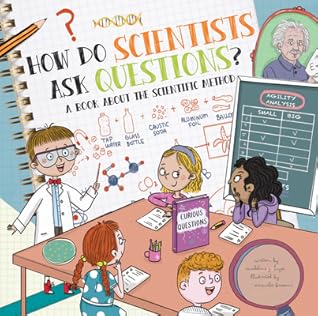
How Do Scientists Ask Questions?: A Book About the Scientific Method
by Madeline J Hayes, Srimalie Bassani (Illustrations)
This children’s book introduces the scientific method, teaching children how to conduct their own experiments, collect data, and draw conclusions or theories. There are experiments and crafts to try at the back of the book to prove Newton’s laws about gravity, create your own DNA model from candy, or make a fossil from salt dough.
One section has inspiration from great scientists in history, like Isaac Newton, Marie Curie, Rosalind Franklin, Albert Einstein, and Thomas Edison. It also includes a little section about Charles Darwin, saying that he was the “originator of the theory of natural selection.” I was glad that this book makes it clear that natural selection and evolution are theories and are not proven fact.
This is such a fun book! I love the cute illustrations and the hilarious characters. The information is clearly explained step by step in a playful way that makes it memorable.
Disclaimer: I received a copy of this book from the publisher in exchange for a free and honest review. All the opinions stated here are my own true thoughts, and are not influenced by anyone.
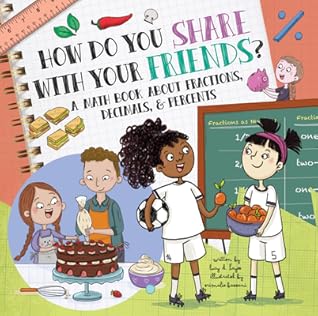
How Do You Share With Your Friends?: A Math Book About Fractions, Decimals, & Percents
by Lucy D Hayes, Srimalie Bassani (Illustrator)
We use fractions and percents in our everyday lives without even realizing it. We use fractions to tell time, saying “half an hour”. We use decimals to calculate money when we buy or sell something. We can even use these math skills to divide up the work between friends, cut up slices of cake to share, or run a lemonade stand and split the profits.
I really liked how this book makes math simple and fun. There are so many everyday scenarios where we need to use fractions or decimals, and we can even use them interchangeably for the same amounts. Some of the examples are hilarious as the characters have to do their chores, or clean up the kitchen, or eat a pizza. If they only do half the chores, or eat 1/4 of the pizza, they are using their math skills!
This is such a fun book! I love the cute illustrations and funny characters. The information is clearly explained step by step in a playful way that makes it memorable.
Disclaimer: I received a copy of this book from the publisher in exchange for a free and honest review. All the opinions stated here are my own true thoughts, and are not influenced by anyone
 Luminous Libro