
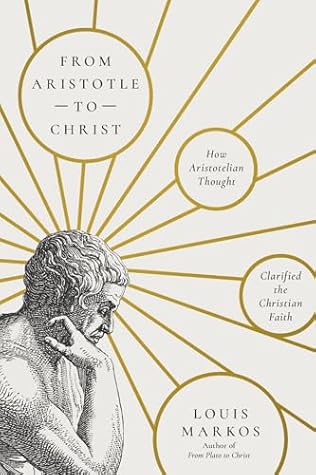
From Aristotle to Christ: How Aristotelian Thought Clarified the Christian Faith
by Louis Markos
Aristotle, like his teacher Plato, had a particular way of asking questions about the world and organizing information in the way that seemed most logical to him with the information he had available. Even without the direct revelation of the Bible, Aristotle intuited some universal truths that have helped Christians to examine their faith more closely and find deeper truths in the Bible than Aristotle ever dreamed of.
Reading this book has helped me to look deeper into my own faith and ask myself, Why do I really believe this? Even seeing where Aristotle got it wrong has forced me to ask the hard questions and wonder, Why do I know that Aristotle was wrong about this? What does the Bible say about it, and how do I know that the Bible got it right? No wonder the subtitle of this book is “How Aristotelian Thought Clarified the Christian Faith”! It really forces you to think deeply and follow each train of logical thought to its conclusion.
I loved the writing style of this book! It’s scholarly, but easy to read and understand even if you know nothing about Greek philosophy. We not only explore the way in which the pagan philosophies point to Christ and a Creator God, but also how ancient wisdom has shaped all of Western thought. Each chapter gives a synopsis of the basic ideas from Aristotle’s writings and what he taught, and then we can analyze the main themes and symbols and see how they have been reflected in Christianity through the centuries. Although Aristotle believed a lot of misguided and false ideas, he still has some little nuggets of wisdom to teach us today.
The first section is titled “How To Think Logically” where we learn how to think about thinking, the essence of philosophy. We examine the Law of Noncontradiction which says that “something cannot be itself and its opposite at the same time and in the same way.” Basically, there is a reality and a truth that cannot be something else. A thing can’t be both wrong and right at the same time and in the same way. It must be one or the other. Absolute truth does exist. I loved the way that this chapter breaks down relativism and proves that it is a very poor erroneous way of trying to explain the universe. There is also a great quote from C.S. Lewis about the nature of God and reality, and how we can see the order in the laws of the universe and know that God is a logical God.
We spend some time exploring Aristotle’s categories that divide things by their different qualities, by which we can form arguments and make positive or negative statements and arrive at logical conclusions with inductive or deductive reasoning. This type of careful step-by-step thinking is one of the reasons for most of the scientific discoveries of the modern age, mainly based on the Christian philosophy that the world created by God is rational and ordered and we can study and understand its workings. If you believe that the world came into being through chance, then you would expect to see chaos when you study science. But Christians approach science knowing that God created all things with a specific design and purpose, and they expect to find rational measurable natural laws that govern the universe. God also created our reason and gave us the ability to perceive reality as it truly is.
There is a section about motion and change in the world and how time continues in an ever-flowing present. This chapter examines the nature of time and how we perceive it, and there is a wonderful section about how Augustine examines the way that God exists outside of time, using Aristotle’s arguments about the transient nature of time to prove that God is both eternally at work and eternally at rest.
Plato (Aristotle’s teacher) believed that you are a soul that is trapped inside a body and that you could be reincarnated into some other body or form. But Aristotle disagreed with his teacher, and believed that the body and soul are fused together in their most intricate parts, and there can be no separation in their essence. Aquinas confirms this for the Christian, since we will have a body in the afterlife in heaven or hell, and even our soul in death has the imprint of the body as the physical representation of the potentiality of the soul. You are one being- with a soul and a body, and a mind and a brain, and a heart and a spirit, all working together to actualize who you are.
Then comes a section about cause and effect, and we examine four different types of causes: the material cause- what a thing is made of; the formal cause – the archetype or essence of a thing; the efficient cause – the primary source of change; and the final cause – the purpose of a thing.
So for mankind, we are made up of flesh and bone, our archetype is that we are mammals with a large brain size, our primary source is our biological parents, and our final cause is to glorify God who created us. Aristotle follows the logic backward to a First Cause, an Unmoved Mover, who started everything in motion at the beginning of the universe, but He Himself remains unmoved by a cause, uncreated. God must exist because there is no other explanation for the first cause of all creation. Everything in existence is caused by something that came before it, but God exists outside of the universe He created, outside of time or space. The chicken came before the egg, and God created the chicken.
The first cause also brings us to examine the final cause. “Telos” means the purpose or end to which a thing is moving. Aristotle argues that the reason we see mistakes and errors in the world is because we intuitively know the true telos for the universe, so when something does not align with the intended design for creation, we are naturally offended and upset by the tragedy. For Christians it is clear that this telos is designed by God for our enjoyment of His glory.
Now of course, Aristotle got a lot of things wrong. He imagined God as being perfectly at rest in eternal contemplation with no interest in puny human beings on earth. This “pure actuality” with no potent movement is Aristotle’s logical conclusion after seeing an ordered and logical universe. Without the further truth of the Bible, Aristotle could not see the power of God’s love and divine revelation of Himself in the person of Christ. Aristotle’s initial arguments are useful to Christians for proving that there has to be an Unmoved Mover, proving the existence of God by pure logic; but God is not a God of only pure logic – He is also benevolent and active and very personal. This chapter analyzes writings from Anselm and Descartes and Leibniz and Alexander Pope to further explore the nature of God, showing how Aristotle’s arguments were the jumping off point for many Christian thinkers of history.
I especially liked the chapter about the order of the cosmos and the way that Aristotle viewed the planets and stars with the moon as the dividing line between realities. It was really interesting to see how medieval scientists and poets like Dante and Chaucer were inspired by the “circles within circles” and the concept that the stars could balance providence and fate. Even as Christians, we have to wrestle with the paradox of free will and predestination, knowing that our individual free choices are part of a larger destiny, a greater “telos”. Since God sees all of reality in an eternal “now” outside of time, Christians can rest in the knowledge that God’s foreknowing of all that will ever happen has given us freedom to exercise our free will within His Love. The author says “…there is a divine providence that transcends our earthly fate, even when we are ignorant of it. God is in control, and He will work out His will, even if it should take a thousand years.”
Then we come to a section about the “psyche”, examining the body, mind, and soul and how they function together. Although Plato believed that the soul has three parts (rational, appetitive, and spirited), Aristotle believed that the appetitive part of the soul is present everywhere in the soul, guiding and regulating the desires of the person, moving us toward or away from something we want or don’t want. What causes strife within a person’s psyche is when they have opposite desires, like wanting to workout and be healthy but also wanting to stay in bed and eat chocolate. This is where Aristotle refines the ideas of virtue (courage, temperance, wisdom, and justice) that would shape all of Western civilization and set the foundation for the more specific Christian virtues (faith, hope, and love). In the end, Aristotle and Christian thinkers like C.S. Lewis come to the same conclusion that “virtue” is not a set of moral rules, but a certain quality that a person has after having developed a habit of following the moral rules. The virtue itself is that internal quality which prompts a person to have the desire to do what is virtuous. Training the will to choose the good for its own sake is the road that leads to virtue becoming a character trait.
Aristotle shaped our laws in more ways than we realize, because he recognized that attitudes matter as much as or more than actions. If you willing choose to commit a crime, you are much more guilty than someone who unknowingly or accidently committed a crime. Your intent matters. We are morally responsible for our own choices, and those choices shape our character for good or ill. The author says “Evil is evil precisely because we practice it knowingly.” So we discern between a person’s good and evil actions, not by their outcome, but by the person’s intent. We either blame or pity the person because of Aristotle’s distinction between attitudes and actions, and our justice system does as well.
I really loved the chapter about finding the “golden mean”, the balance between extremes. Much of Christian thought is influenced by finding the perfect balance, the complete and full expression of virtue as it ought to be. There are many extremes that are explored in the Bible and Aristotle examines them too. The virtue of generosity could be twisted in different directions – you could be too liberal and generous with your resources to the point where you are wasting them, or on the other extreme you could be a greedy miser. The perfect expression of generosity is found in the middle, where you give freely, but with good stewardship and wise judgement.
The next few chapters examine our relationships with each other, showing how Aristotle viewed personal relationships in the family and community, where he got it wrong, and how the Bible shows us a better way to interact with our fellow humans. Aristotle had some terrible ideas about slavery and women’s rights that are certainly a product of his time in history, but even in his errors there are kernels of questions that lead to a more Biblical relation between people under our Creator. It is only in the Bible that we learn we are created in equal dignity and value.
I was intrigued by Aristotle’s praise of the life of contemplation, saying that the life where you have the leisure to just think and learn is the most perfect and complete way of life. But the Bible sanctifies work and contemplation in equal measure, while Aristotle looks down his nose at the working man. Even medieval monks influenced by this philosophy would separate themselves from self-promoting work to devote themselves to pure spiritual thought. In the modern day, we use busyness as a spiritual wall so that we don’t have time or take time to be still and know God. In the light of the constant modern grind, it is interesting to see how Aristotle prioritized contemplative learning over commercial activity as a means of bringing true happiness and fulfillment to your life. But the Bible gives us a deeper truth, that all work is sacred when it is dedicated to God, bringing together spiritual contemplation and everyday tasks in a holy union.
There is a lengthy exploration of the Enlightenment movement and how Aristotle was closer to the absolute truth of Christianity than to the relativism of the Enlightenment. Aristotle had what the author calls a “long influence” on political thought, social management, and economic institutions of the West. The most important might be his strong belief in private property being the bedrock of civilization. There is a beautiful section that admires the work of Scottish philosopher Alasdair McIntyre, and how he used Aristotle’s examinations of government and private property to argue for moral education that is then properly exercised in preserving that property.
There are chapters that examine types of government and the philosophy that the law should rule, no matter what type of government is employed to enforce the law. We explore “customary laws” which are instinctively known to all people in all cultures, and “written laws” which are the actual written codes of law for an individual country or city. We see how Aristotle’s categories of law had an influence on the founding fathers of America with their belief in the inalienable rights that are common to all mankind.
And the final section is about poetry and the arts. I was delighted to see a quote from Dorothy Sayers about classical education needing a foundation in grammar, logic, and rhetoric in order to shape virtuous citizens. Each person needs the ability to think clearly and communicate clearly, or the author says they will be “left to the mercy of advertisers and propagandists.” Aristotle was very adamant about the proper use of rhetoric, not to confuse the truth, but to clarify it and bring the listeners to a better understanding. The author shows how many Christian martyrs and great Christian philosophers used Aristotle’s type of rhetoric to convince their audience of the truth of Christ. Although Plato condemned the arts as a mere imitation of a shadow, Aristotle saw that the arts, poetry, and theater could be used to reveal great truths about the world, and through a story provide a catharsis of emotion that teaches us how to be more virtuous. I especially loved the section explaining how Milton (my favorite poet) modeled his own poetry after Aristotle’s philosophy of evoking cathartic pity and fear in his epics.
Overall, I enjoyed this book so much! It took me a long time to read, because I kept stopping to ponder and think and digest all the wonderful philosophy in each chapter. The best thing about this book is that it all points back to Christ! Every question that Aristotle asks, every philosophical exploration leads in the end to the Creator of all.
Disclaimer: I received a copy of this book from the publisher in exchange for a free and honest review.
 Luminous Libro