
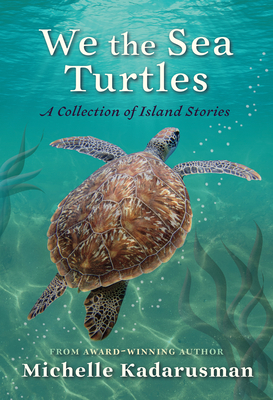
We the Sea Turtles
by Michelle Kadarusman (Goodreads Author)
This collection of short stories follows different children around the world who encounter sea turtles in some way. Each child is inspired by the turtles to live their life with courage and be true to themselves.
I enjoyed the basic stories, but I got so annoyed with the constant preaching about the environment that I DNF’d the book at page 103. It was even more annoying because some of the things the characters were saying about the environment and pollution and carbon footprints are only theories, not fact. So it was weird that they were talking about climate change, but not giving all the facts.
I also felt that each story was too short to give a full character arc. It felt sort of disappointing to get to know this lovely character and start to care about their thoughts and feelings, and then their story abruptly ends. But that shows that the writing was good enough to get me emotionally involved with the characters. The actual writing is really beautiful and inspiring! I just think the story structure needed more time to develop. Short stories are notoriously difficult to write. It’s tough to balance the story arc and character development in a short form.
There is also a disclaimer at the beginning of each story talking about the rights of the native peoples for each area where the stories are set. I was sort of confused by this because most of the stories don’t include native people in the story. They all appear to have modern settings, so I’m not sure what purpose the disclaimer was supposed to serve. Oddly, the only story I read which actually had native Indonesian characters was the only story that did NOT have a disclaimer. Apparently, the author thinks that if a fictional story has a setting in any real place that people used to live, you have to acknowledge that people lived there hundreds of years ago. Doesn’t make any sense to me, but I guess it’s nice to learn about the history of different places in the world. It has no connection to the actual story you read though, so it seems very out of place.
Disclaimer: I received a copy of this book from the publisher in exchange for a free and honest review. All the opinions stated here are my own true thoughts, and are not influenced by anyone.
 Luminous Libro
Regarding this review for We the Sea Turtles. I think some clarity is in order. Pollution is not a theory, it is a fact. Does your car have exhaust? This is pollution. Do you put the garbage out every week? This is pollution. When you drive by a factory, do you see gases being emitted by the venting stacks? This is pollution.
Similarly, a carbon footprint is a quantifiable fact, not a theory. It’s simply a way of measuring carbon emission. While you may not understand it, carbon emission is factual byproduct of our society. A carbon footprint is no less a fact than the square footage of your home’s roof. Objectively measurable and verifiable.
What you seem to be conflating is climate change theory and the (undeniable) facts which lead scientists to hypothesize this theory. It’s true that climate change science is still in its theoretical stage. Only 95-98% of creditable scientists currently ascribe to it. Gravity was also once a theory when Isaac Newton postulated it. Now, we can send men to the moon because, in part, we can quantify the force of gravity in precise and factual terms.
Regarding, as you curiously refer to them, the ‘disclaimers’ preceding the stories. These are land acknowledgements. A land acknowledgement simply recognizes that the indigenous people of a particular area have been for thousands of years and continue to be to this day, stewards of that land. That’s all. It doesn’t in any fashion recognize or assert any kind “rights of the native peoples.”
I would hasten that you refer to a definition of the word “steward”. A steward’s responsibility and commitment to future generations is not forsaken because they no longer rule or predominate in a certain geographic region.
BTW, it may surprise you to learn that indigenous people lived in North America not just hundreds of years ago, but do so to this day. So the covenant of stewardship endures.
A land acknowledgement is a respectful recognition of this stewardship.
Finally, as you’ll agree, this is a book of short stories for children. So “giving all the facts” about climate change would be pretty wordy. Something more appropriate to a scientific paper or textbook, perhaps. There are really only two facts about climate change that are important:
Someday, these facts will be considered more than just theoretical. I just hope and pray there’s an Earth left at that point to save.